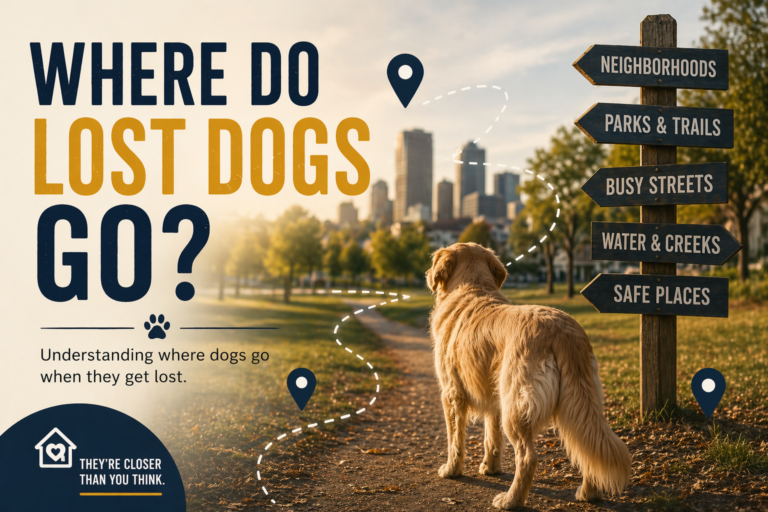
Where Do Lost Dogs Usually Go in Kansas City?
If your dog is missing, one of the most important questions is where they may have gone. Lost dogs do not move randomly — they follow patterns based on fear, environment, and pressure.
Understanding these patterns helps — but locating your dog quickly is what actually leads to recovery.
Step 1: Locate Your Dog Before It Moves Farther
The fastest way to find where your dog actually went is with a thermal drone search. Instead of guessing based on patterns, thermal imaging can scan large areas and detect your dog’s heat signature.
KC Aerial Vision uses thermal drone search to locate lost dogs quickly before they move outside a predictable area.
If your dog just went missing, start with what to do immediately when your dog goes missing.
Do Lost Dogs Stay Close to Home?
Many lost dogs stay within a relatively small area early on — often within a few blocks to about a mile.
This is the best opportunity to locate your dog before it begins traveling farther.
Common Places Lost Dogs Go
Lost dogs tend to follow paths of least resistance and areas that feel safe or familiar.
- Neighborhood streets and sidewalks
- Parks and open fields
- Walking trails and greenways
- Tree lines and wooded edges
- Drainage areas and creeks
- Backyards and quiet residential areas
These areas matter — but searching them on foot alone can take too long if the dog is moving.
Why Dogs Keep Moving
Many dogs continue moving because they are scared or in a survival mindset. Noise, people, traffic, or chasing can push a dog farther away.
Every time the dog is pressured, it is more likely to leave the area.
Important:
If your dog is moving, the priority is no longer searching — it is locating. Thermal drone search is often the fastest way to do that without pushing the dog farther.
Do Lost Dogs Travel Far?
Some dogs remain close, while others can travel several miles depending on fear and time missing.
The longer the delay, the larger and more unpredictable the search area becomes.
How to Predict Where Your Dog Went
- Last known location
- Direction of travel if seen
- Nearby parks, trails, or open areas
- Quiet areas where a dog may hide
Prediction helps — but it does not replace locating your dog.
Why Thermal Drone Search Changes the Search
A thermal drone allows large areas to be scanned quickly from above, identifying heat signatures that cannot be seen from the ground.
- Finds dogs hidden in fields, brush, and terrain
- Covers large search areas quickly
- Reduces pressure from ground searching
- Provides real-time location data
- Helps guide safe recovery instead of chasing
Thermal drone search is often the separator between guessing where a dog went and actually finding it.
When to Get Help Finding a Lost Dog
If your dog is not found quickly or continues moving, do not wait.
Call KC Aerial Vision immediately to start a thermal drone search before the search area expands.
Find Where Your Dog Actually Went
KC Aerial Vision provides thermal drone search across Kansas City to locate lost dogs quickly and accurately.
Thermal drone search is often the fastest way to turn uncertainty into a real location.
Call 913-707-3156 Get Help NowFinal Takeaway
Lost dogs follow patterns — but they do not stay in one place for long.
Thermal drone search is often the key advantage in finding where your dog actually went before the situation becomes more difficult.
Lost Dogs Usually Follow Cover, Quiet, and Easy Travel Paths
Lost dogs often move through areas that feel safer than open streets. In Kansas City neighborhoods, that can include creek beds, drainage areas, fence lines, tree lines, trails, golf courses, parks, industrial edges, and quiet residential corridors.
Cover Routes
Tree lines, brush, creek beds, wooded edges, and drainage corridors give scared dogs a way to move while staying hidden.
How far lost dogs travel →Quiet Areas
Dogs may settle near low-traffic neighborhoods, parks, sheds, backyards, school fields, industrial lots, or places with less human activity.
Best time to search →Fear-Based Movement
A scared dog may ignore familiar voices and continue moving if people chase, call loudly, or flood the area.
Why dogs won’t come back →Night Movement
Many lost dogs become more active during quiet evening, overnight, or early morning windows when pressure drops.
Find a lost dog at night →More Help for Understanding Where Lost Dogs Go
These guides explain lost dog travel distance, scared dog behavior, nighttime movement, first-hour response, and thermal drone recovery throughout the Kansas City metro.