Lost Dog in Kansas City?
JOCO Pet Search & Rescue provides thermal drone search and guided recovery to locate and safely recover lost dogs — without pushing them farther away.
Serving Kansas City, Johnson County, Olathe, Overland Park, Lenexa, Shawnee, Liberty, Blue Springs, Independence, Lee’s Summit, and surrounding areas.
📞 Call Now: 913-707-3156How Far Do Lost Dogs Travel in Kansas City?
If your dog is missing, one of the most important questions is how far they may travel — because distance determines how quickly the situation becomes harder to control.
Many owners search how far do lost dogs travel, how far can a lost dog go in a day, or how far will a scared dog run. The answer depends on behavior, environment, and how quickly the dog is located.
The goal is not just to understand distance — it is to locate your dog before that distance increases.
Step 1: Locate Before the Search Area Expands
The fastest way to prevent a lost dog from traveling farther is to locate them early using a thermal drone search.
JOCO Pet Search & Rescue uses thermal drone search across the Kansas City metro to scan large areas quickly, detect heat signatures, and locate dogs before they move outside a manageable range.
How Far Do Lost Dogs Usually Travel?
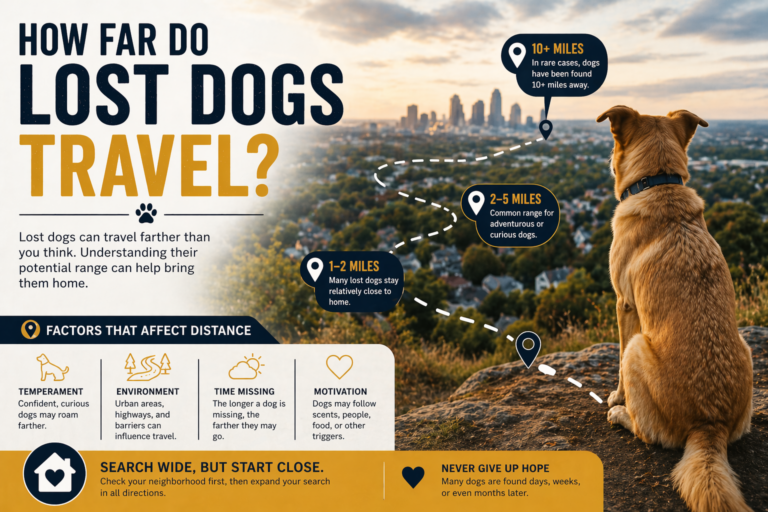
In the early stages, many lost dogs remain close to home — often within a few blocks to about a mile.
This is why people searching how far do lost dogs go from home often find that early recovery is possible when action is taken quickly.
This is the most important window to locate your dog.
How Far Can a Dog Travel in 24 Hours?
A lost dog can travel several miles within 24 hours, especially if it is scared or continuously moving.
Dogs in survival mode often move in straight lines, follow terrain edges, and avoid people — increasing total distance quickly.
This is why searches for how far can a dog travel after escaping show rapidly expanding search areas.
Important:
A moving dog turns a small search into a large one quickly. Thermal drone search is most effective before the dog expands beyond the initial area.
Do Lost Dogs Keep Moving or Stay in One Area?
Many dogs move continuously at first, especially when scared. Over time, some begin to slow down and settle once they feel safer.
The challenge is locating the dog before that settling phase happens in an unknown location.
What Affects How Far a Lost Dog Will Travel?
- Fear level and personality
- Environment and terrain
- Weather conditions
- Human interaction or chasing
- Traffic and activity levels
Dogs that are chased or pressured are much more likely to travel farther — which is why many searches for scared dog keeps running away lead to expanding search areas.
Why Distance Changes the Recovery Strategy
Once a dog begins moving, recovery becomes less about walking the neighborhood and more about locating the dog quickly.
Thermal drone search allows large areas to be scanned efficiently, especially fields, wooded edges, parks, and neighborhoods.
Why Thermal Drone Search Is Critical
- Faster coverage of expanding search areas
- Detection of dogs hidden in terrain
- Reduced pressure from ground searching
- Real-time location data
- More controlled recovery planning
JOCO Pet Search & Rescue uses thermal drone technology across Kansas City to locate dogs quickly and reduce search time.
When to Get Help Finding a Lost Dog
If your dog is not found quickly or continues moving, do not wait.
Call JOCO Pet Search & Rescue immediately to start a thermal drone search before the search area expands further.
Stop the Search Area From Growing
JOCO Pet Search & Rescue provides thermal drone search across Kansas City, Johnson County, Liberty, Blue Springs, Independence, and Lee’s Summit.
Thermal drone search is often the fastest way to turn distance into a known location.
Call 913-707-3156 Get Help NowFinal Takeaway
Lost dogs can travel quickly — especially in the first 24 hours.
JOCO Pet Search & Rescue combines behavior strategy and thermal drone technology to locate dogs before the search area becomes too large.
Lost Dogs Do Not Always Travel Randomly
A missing dog may cover distance quickly, but movement often follows patterns. Dogs commonly use tree lines, creek beds, fence lines, trails, drainage areas, quiet neighborhoods, golf courses, industrial edges, and wooded corridors to avoid people and traffic.
First Few Hours
Many dogs are still within a manageable search radius early on. This is the time to protect the last known area and avoid pushing the dog farther.
First hour missing dog steps →Scared and Running
A frightened dog may ignore its owner, avoid people, and keep moving if chased. This can turn a close search into a multi-mile recovery.
Why dogs won’t come back →Night Movement
Many dogs move more during quiet evening, overnight, or early morning windows when traffic and human activity are reduced.
Find a lost dog at night →Expanding Search Area
Once distance increases, recovery depends on identifying patterns, narrowing likely areas, and using technology to cover ground quickly.
Thermal drone search →More Help for Tracking a Lost Dog’s Movement
These guides explain how lost dogs move, when they travel, why they avoid people, and how thermal drone recovery helps narrow a growing search area.