Lost Indoor Cat in Kansas City?
JOCO Pet Search & Rescue provides thermal ground scanning, thermal drone search, and humane cat trapping to locate and safely recover hidden cats.
Serving Kansas City, Johnson County, Olathe, Overland Park, Lenexa, Shawnee, Liberty, Blue Springs, Independence, Lee’s Summit, and surrounding areas.
📞 Call Now: 913-707-3156How Far Will an Indoor Cat Go After Escaping?
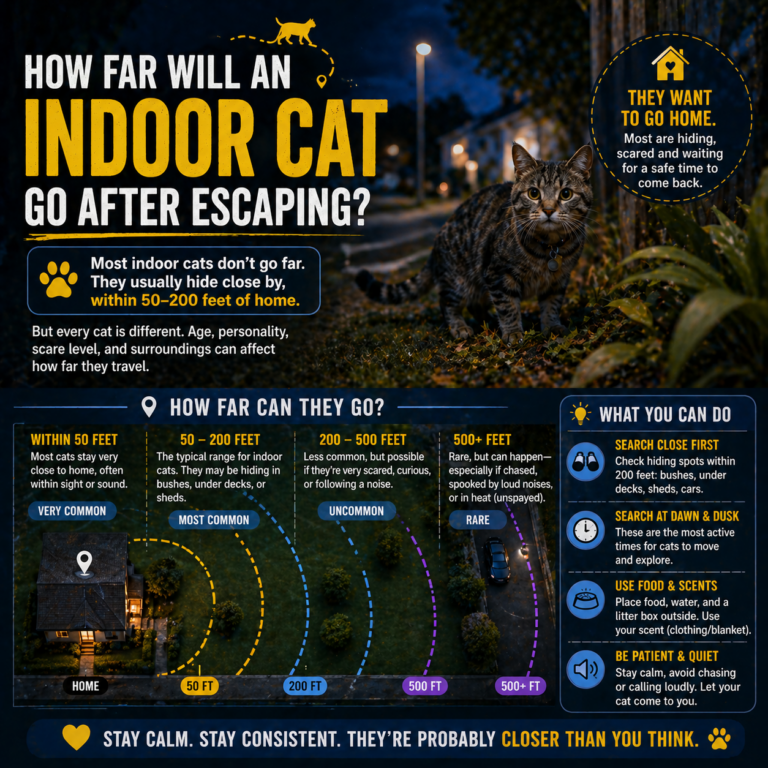
Most indoor cats do NOT go far after escaping.
This is one of the biggest misconceptions. Owners often assume their cat ran blocks away — when in reality, the cat is usually hiding very close to where it got out.
The problem is not distance. The problem is visibility.
Indoor cats hide extremely well, stay silent, and often won’t come when called.
Indoor Cat Missing?
Thermal ground scanning and humane cat trapping can locate and recover cats hiding close to home.
Call Now: 913-707-3156Most Indoor Cats Stay Within a Very Small Area
In the early stages, most indoor cats stay within:
- The same property
- Neighboring yards
- Within 1–3 houses of the escape point
They are not exploring — they are hiding.
This is why searching far too soon is one of the biggest mistakes.
Why Indoor Cats Don’t Travel Far
Indoor cats are not used to outdoor environments. When they escape, they are suddenly exposed to:
- Open space
- Noise and traffic
- Dogs and unfamiliar animals
- People and movement
This causes a fear response.
Instead of traveling, the cat looks for immediate cover and stays hidden.
Where They Usually Hide Instead of Traveling
If your cat escaped, they are most likely hiding in one of these areas:
- Under decks and porches
- Behind bushes and landscaping
- Under sheds
- Under vehicles
- Inside crawl spaces
- Along fence lines
They may be close enough to hear you, but too scared to respond.
Thermal Ground Scanning Helps Confirm If Your Cat Is Close
Because indoor cats hide so well, visual searching often fails.
A thermal ground scan can help detect heat signatures under decks, bushes, sheds, and other hidden areas.
This allows you to confirm whether your cat is still nearby without pushing them farther away.
Humane Cat Trapping Is the Most Reliable Recovery Method
If your cat is close but hiding, the goal is not to chase — it is to draw them into a controlled recovery point.
Humane trapping works because it:
- Uses scent to attract the cat
- Works during nighttime movement
- Does not rely on the cat approaching people
A properly set trap with camera monitoring is often the turning point in recovering an indoor cat.
Your cat is likely still close — just hidden.
This is exactly when thermal scanning and trapping become critical.
Get Cat Recovery HelpWhen Do Indoor Cats Start Moving Farther?
Indoor cats may begin to move farther only if:
- They are chased or scared repeatedly
- The area becomes too active or noisy
- No controlled scent or feeding point is established
This is why early control of the situation is critical.
What You Should Not Do
Do not assume your cat is far away. Do not expand your search too quickly. Do not chase your cat if you see them.
These actions can push the cat farther away and make recovery more difficult.
The Best Recovery Plan
- Search close to the escape point.
- Check all low, covered hiding areas.
- Use thermal ground scanning when needed.
- Create a controlled scent and feeding location.
- Monitor with a camera.
- Use humane trapping if the cat will not approach.
This keeps the cat close and creates a clear recovery path.
KC Pet Search & Rescue Can Help
KC Pet Search & Rescue helps recover indoor cats using thermal ground scanning, scent strategy, camera monitoring, humane cat trapping, and thermal drone support when needed.
If your cat just escaped, this is the best time to act.
Your cat is likely still close. Let’s recover them before they move farther.
Call now for indoor cat recovery services in the Kansas City area.
Call 913-707-3156Frequently Asked Questions
How far do indoor cats usually go after escaping?
Most stay within a few houses of where they escaped, especially in the early stages.
Why is my indoor cat not coming back?
Fear causes indoor cats to hide and stay silent, even when they hear their owner.
What is the fastest way to recover an indoor cat?
Search close, confirm presence with thermal scanning or cameras, and use humane trapping if needed.
Should I chase my cat if I see it?
No. Chasing can push the cat farther away. Controlled recovery methods are more effective.
When should I call for help?
If your cat is missing, hiding, or not responding, early intervention improves recovery success.
How Far Indoor Cats Usually Go After Escaping Outdoors
Most escaped indoor cats stay hidden much closer than owners expect. These recovery guides explain indoor cat movement patterns, hiding behavior, nighttime activity, and how thermal scanning and humane trapping systems help improve recovery success throughout the Kansas City metro.
Indoor Cat Recovery Services
Emergency indoor cat recovery services using thermal drones, thermal ground scanning, and humane trapping systems throughout Kansas City.
Indoor Cat Movement & Hiding Behavior
Indoor cats usually stay within a small hiding radius, often under decks, sheds, brush, woodlines, or nearby structures.
Thermal Drone & Ground Search Strategy
Thermal technology helps determine whether a hidden cat is still nearby before search areas expand too far from the escape point.
Indoor Cat Trapping & Recovery
Humane trapping systems become critical once indoor cats settle into hiding locations and stop responding to owners directly.
Kansas County Recovery Areas
Indoor cat thermal recovery and trapping support throughout major Kansas counties surrounding Kansas City.
Missouri County Recovery Areas
Emergency indoor cat recovery coverage throughout Missouri metro counties and surrounding search areas.